20 Fun Facts About what type of sharpening stone do i have

Types Of Dental Sharpening Stones – Truths

The function related to the red line across it determines about 0.08 mm throughout. The dark area at upper left is a void developed to allow for swarf created throughout sharpening types of sharpening stones to be cleared from the diamonds. This reasonably coarse stone would be utilized to reshape a damaged blade edge which would be refined by finer grit stones.
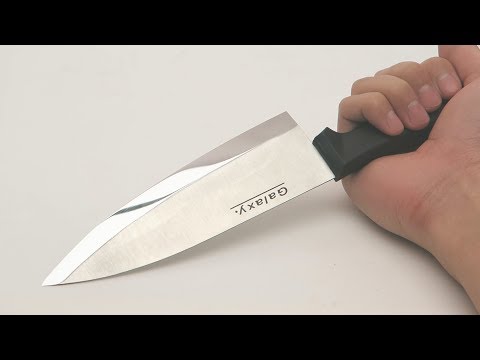
Part of the trouble is that "grit size" is utilized to refer to the smoothness of the finish produced by a sharpening stone, and not simply the real size of the grit particles. Other factors apart from particle size that impact the finish (and thus the "grit size" score) are: the shape of the abrasive particles, how much of each particle is exposed by the binder, friability (whether the abrasive particles can be fractured into smaller sized ones by the pressure of grinding or polishing), the solidity of the abrasive particles, and the chemical composition of the abrasive particles (typical abrasives consist of diamond, cubic boron nitride (CBN), chromium( III) oxide, tungsten carbide, silicon carbide and other ceramics).

Sandpaper also uses a comparable system. Here are some common sharpening stone grit sizes and their uses when sharpening steel knives: Grit size Approximate particle diameter Common usage 200 80 μm Removing chips from a damaged blade 500 30 μm Approximately honing a blunt edge 1000 8 μm Smoothing a rough edge into a medium edge 4,000 4 μm Smoothing a medium edge into a sharp edge for cutting meat 8,000 2 μm Further smoothing a sharp edge for cutting fish or veggies (sinews in meat will bend an edge this sharp) 30,000 0.5 μm Polishing an edge to a mirror-smooth (but potentially delicate) finish.

Some Ideas on What Are The Different Types Of Sharpening Stones You Need To Know

^ "" Whet", Dictionary.com". Obtained 25 July 2016. ^ " Online Etymology Dictionary". Obtained 25 July 2016. ^ Oxford Living Dictionaries ^ "" Stoning", Dictionary.com". Obtained 25 July 2016. ^ Leon S. Griswold, The Novaculites of Arkansas in Yearly Report of the Geological Study of Arkansas, Volume 3, 1892, offered http://query.nytimes.com/search/sitesearch/?action=click&contentCollection&region=TopBar&WT.nav=searchWidget&module=SearchSubmit&pgtype=Homepage#/whetstone on Google Books ^ coticule.be ^ English, John (2008 ), Woodworker's Guide to Honing: All You Required to Know to Keep Your Tools Sharp, Fox Chapel Publishing, p.

^ Ambrose, K et al. (2007 ). Checking out the Landscape of Charnwood Forest and Mountsorrel. Keyworth, Nottingham: British Geological Study ^ Steve Bottorff, Honing Facilitated: A Primer on Sharpening Knives and Other Edged Tools, Knife World Publications, 2002, ISBN 0940362198, pp. 29-39 ^ Adam Cherubini (12 October 2011). " What is an Oilstone?".

Obtained 22 February 2017. ^ David A.Warren, Getting and Edge the Japanese Method, Popular Mechanics, January 1984, pp. 104-107 ^ Thomas Klenck, Tool Test: DMT Diamond Sharpeners, Popular Mechanics, March 1991 pp. 62-63 ^ Miller, Jeff (2012 ). The Foundations of Better Woodworking: How to utilize your body, tools and materials to do your best work, Popular Woodworking Books, 2012 ISBN 1440321019, page 120 ^ a b wonkeedonkeetrend.co.uk ^ " Whetstones: it's all in the grit!".

All about Types Of Diamond Sharpening Stones

Retrieved 3 January 2019. ^ " Sharpening stone grit chart". sharpeningsupplies. Recovered 3 January 2019. ^ " The Grand Unified Grit Chart". bladeforums.com. p. 1. Recovered 3 January 2019. ^ " The Grand Logarithmic Grit Chart". gritomatic.com. Obtained 3 January 2019. ^ " Stone, Belt, Paper, Movie and Substance Grit Comparison" (PDF). imcclains.com. Retrieved 3 January 2019.

The 3 most common kinds of sharpening stones are oil stones, water stones, and diamond stones. Each of these stones has its own benefits that can help users achieve their honing objectives. Oil stones are the traditional Western stones that numerous people grew up using. These stones are made from one of three products (Novaculite, Aluminum Oxide, or Silicon Carbide) and utilize oil for swarf (metal filing) elimination.

These natural stones are quarried in Arkansas and processed to make what we call Arkansas Stones. These stones are separated into various grades connected to the density and the finish a stone produces on a blade. The coarsest of them are called Washita. The Washita is not often used these days since it is very soft.

How Oil Stones, Water Stones, And Diamond Stones can Save You Time, Stress, and Money.

These natural oil stones can produce a refined edge, but tend to cut more gradually than manufactured stones. The Tough Black Arkansas and Hard Translucent are more unusual and are for that reason more costly. The Aluminum Oxide oil stones are an incredibly popular man chosen – types of whetstones. The most popular are called India Stone which are made by Norton.

The grading system for these stones is generally labeled fine, medium, and coarse. These stones are often brown or orange in color. When compared with the Arkansas stones, Aluminum Oxide (India Stones) are more coarse. The India Stones are utilized in conjunction with Arkansas Stones to cover all levels of coarseness.

The silicon carbide stones made by Norton are called Crystolon stones. These stones are likewise identified fine, medium, and coarse. They are usually gray in color. While these stones will not produce an edge as fine as the India or natural stones, the fast cutting makes them ideal for preliminary coarse sharpening.

Everything about What Are The Different Types Of Sharpening Stones

The good overall performance and the lower price are the oil stone's biggest assets. A set of India or Crystolon stones are the least pricey stones to buy. The natural Arkansas Stones differ in cost from the extremely affordable Soft Arkansas to the more costly Difficult Black and Clear Arkansas Stones.

The main disadvantage of the oil stone is its slower cutting rate. Of the three primary stone types, the oil stone is the slowest. The fact that oil is used to eliminate the swarf is likewise messier to tidy up than water. View Oil Stones Water stones are relatively brand-new to the Western world, however have actually gathered a large following due to their numerous benefits.
7 Simple Secrets to Totally Rocking Your types of sharpening stones

Examine This Report about Ceramic Whetstone Sharpener

The best way of honing a knife is with a whetstone. There are other methods and Finding out the best way to use a whetstone might take a little practice, but once you get the hang of it, you'll have the ability to keep knives razor sharp while conserving time and money.

Dull knives require you to apply more pressure to attain the cut you want, and pushing down harder can trigger the knife to slip. So not just do you cut yourself, but you cut yourself even worse because you were using more force to the knife. See Now: How to Sharpen a Knife With a Whetstone To begin, get a two-sided whetstone, with a coarse grit on one side and fine grit on the other.

In general, it's someplace around 22 degrees. To picture this, photo 90 degrees, which is straight up and down. Then imagine half of that, which is 45 degrees. And then another half of that is 22 1/2 degrees. Don't worry about the half degree. However do seek advice from the technical details that came with your knife, or inspect with the manufacturer to validate the appropriate angle you should be using.

The 7-Second Trick For Arkansas Sharpening Stone

Do not let the name confuse you. Using oil or water on a whetstone traps small metal particles in the liquid, which in turn produce a more rough edge than when using a dry stone. The difference in between a waterstone and a whetstone is that a waterstone is a natural stone, frequently Japanese owing to geological features special to that part of the world.

A whetstone is a different kind of stone, in some cases natural, in some cases synthetic. Some whetstones are OK to wet, others not. For instance, soaking a synthetic whetstone can significantly shorten its life-span. Again, consult the instructions provided by your stone's manufacturer before doing anything you're not particular about. Illustration: Kelly Miller.

Tips Always sharpen in the exact same direction, whether it's front-to-back or back-to-front. Do not believe the hype about knives that supposedly "never require honing." Cutting produces friction, and friction triggers a knife's edge to lose its sharpness. There's no avoiding the laws of physics. Do not attempt to sharpen Take care of your knife so it retains its edge longer.

6 Simple Techniques For Diamond Sharpening Stones

Get Your Great Afternoon Merchandise Here: For additional information on these knives, contact David Holly at david@knifemerchant.com or go to knifemerchant.com Let us know how you enjoy your Minonokuni. Knife Merchant 7887 Dunbrook Road Suite HSan Diego, CA 92126800-714-8226www. knifemerchant.com .

The real procedure of sharpening your hunting knife's edge of your knife's blade is a relatively simple process which may look like it needs little explanation. However there's a lot that actually goes into honing your knife appropriately. For instance, different kinds of blade steels and different types of blade grinds need various grits and different honing angles.

Bushcraft or field knives will more than likely be sharpened by a pocket sharpener as you will have them out in the field. It's likewise essential to have the appropriate whetstone for the task. Finding the right whetstone can be made complex, yet it's an integral part of the knife honing procedure needing a more in-depth explanation.

Excitement About Diamond Sharpening Stones

Contents Whetstone Basics: Blade Grind 101: Blade Steel Grinding Tips: Types of Whetstones: Finish up: Contents 5 Finish up: Before we examine the real process of honing a knife blade's edge, let's first analyze the nature of whetstones. For instance, whetstones are divided into different groups including naturally taking place stones such as Japanese Water Stones and Arkansas Oil Stones and male made stones such as Crystalon (aluminum oxide) and India Stones (silicon carbide).

In addition, there are extra kinds of guy made whetstones such as diamond refines and ceramic hones that can be utilized either with or without water to oil them. Plus, both natural and man made whetstones are available in different grits with the more coarse grits being more abrasive and the finer grits being less abrasive.

So, let's begin with a description of blade grinds however, in order to do that, we first require to specify some terminology. When it comes to a Saber Grind or a Hollow grind, the line located on the side of the blade above the cutting edge that extends from the back of the blade to the idea.

Natural Sharpening Stones – An Overview

Also, the widest cross area of any knife blade is called the Spinal column. For that reason, a Saber Grind is a blade grind who's Main Bevel Line is located low on the face of the blade, near the Leading edge, with either flat or somewhat concave Primary Bevels so that it creates a relatively thick Primary Bevel.

With a Flat Grind, there is no Main Bevel Line because the face of the blade is ground flat from the Leading edge to the Spinal column which creates an edge that is sharper than a Saber Grind and harder than a Hollow Grind. Consequently, knives implied for sturdy usage usually have Saber Grinds whereas, knives implied for basic function usage generally have Flat Grind and, knives implied for hunting generally have Hollow Grinds.

This is important so that they can hold up against the shock produced when the knife is used to chop and, by the same token, blades with Hollow Grinds will require to be sharpened at much lower edge bevel angles (10 to 15 degrees). Blades with Flat Grinds will require to be sharpened at angles in between the two depending of the density of the blade's Spine.

Indicators on Knife Sharpening Stone You Need To Know

For instance, knives with relatively soft blades such as 1095 or SK-5 varying from 50-55 RHC are usually utilized for big, heavy, blades with Saber Grinds and thus, although they sharpen relatively rapidly, they also tend to sustain the best quantity of damage to their edges and thus, they typically require the highest degree of repair usually.

Introduce Yourself (Example Post)

This is an example post, originally published as part of Blogging University. Enroll in one of our ten programs, and start your blog right.

You’re going to publish a post today. Don’t worry about how your blog looks. Don’t worry if you haven’t given it a name yet, or you’re feeling overwhelmed. Just click the “New Post” button, and tell us why you’re here.

Why do this?

  • Because it gives new readers context. What are you about? Why should they read your blog?
  • Because it will help you focus you own ideas about your blog and what you’d like to do with it.

The post can be short or long, a personal intro to your life or a bloggy mission statement, a manifesto for the future or a simple outline of your the types of things you hope to publish.

To help you get started, here are a few questions:

  • Why are you blogging publicly, rather than keeping a personal journal?
  • What topics do you think you’ll write about?
  • Who would you love to connect with via your blog?
  • If you blog successfully throughout the next year, what would you hope to have accomplished?

You’re not locked into any of this; one of the wonderful things about blogs is how they constantly evolve as we learn, grow, and interact with one another — but it’s good to know where and why you started, and articulating your goals may just give you a few other post ideas.

Can’t think how to get started? Just write the first thing that pops into your head. Anne Lamott, author of a book on writing we love, says that you need to give yourself permission to write a “crappy first draft”. Anne makes a great point — just start writing, and worry about editing it later.

When you’re ready to publish, give your post three to five tags that describe your blog’s focus — writing, photography, fiction, parenting, food, cars, movies, sports, whatever. These tags will help others who care about your topics find you in the Reader. Make sure one of the tags is “zerotohero,” so other new bloggers can find you, too.

Design a site like this with WordPress.com
Get started